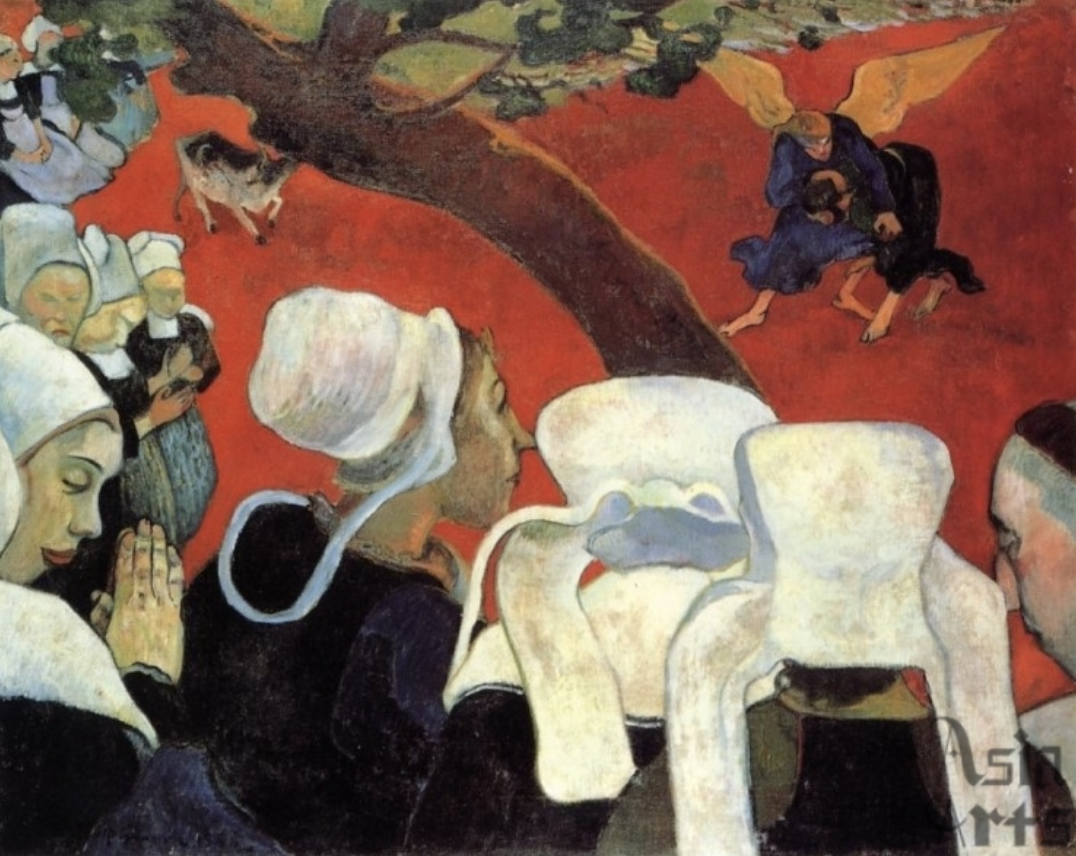
When one gazes at Paul Gauguin’s Vision After the Sermon, Jacob’s wrestling on the red earth appears not merely as an ancient biblical scene, but as the deepest night of the human soul. What is visible is a painting, yet what trembles within it is conscience, memory, and fear. Pastor David Jang’s sermon on Genesis 32 penetrates precisely that point. The night by the Jabbok is not simply a night of suffering. It is the night in which the strength a person clings to until the very end collapses, and in its place the grace of God enters. Peniel is more than a location; it is an event of the soul, the dawn that only those whose hip socket has been struck can behold.
Faith Revealed Only in the Deepest Night
Jacob had fled from his brother Esau, and over the years he gained wealth and a family. Yet within him remained unresolved fear and guilt. Outwardly he looked like a successful man, but in truth he was still captive to his past. Therefore, the wrestling at the Jabbok was not merely a mystical experience, but a spiritual labor in which the old Jacob was broken down and a new being was born. As the sermon emphasizes, this night of wrestling is a mirror that reflects “how each of us must stand before the Lord today.” Faith is not a comfortable religious habit; it is an event in which a person is completely stripped bare before God.
The Door of Peniel Opens When the Hip Socket Is Broken
At the center of this sermon stands the hip socket. The joint of the thigh can be read as a symbol of strength, life, future, and self-respect. Yet God strikes Jacob at precisely that strongest point. This is not merely an injury. It is the moment when the strength I relied on to the very end, the pride that told me I had come this far by myself, and the stubbornness within that refused to let go of my rights all collapse. Pastor David Jang interprets this scene to mean that only when a person is broken does the work of God truly begin. Indeed, Jacob did not become Israel after growing stronger and receiving a new name; he became Israel only after he began to limp. Here a profound theological insight rises up: true blessing is not the reward of strength, but the gift of a new existence given after brokenness.
For that reason, Peniel is not a place reached through religious zeal alone. It does not open because one has served more, believed longer, or knows more. Rather, it opens only when one confesses, “I cannot do this by my own strength. Lord, You must hold me.” This is the essence of grace spoken of in the sermon. Only where human merit disappears does the gospel become truly the gospel.
The Miracle of Reconciliation Begins with a Limping Walk
What is astonishing is what comes next. After receiving a new name, Jacob goes straight to meet Esau. More astonishing still is that he reconciles not when he is strongest, but when he has become weakest. With a body marked by a dislocated hip, he approaches his brother, offers what he has, and confesses that seeing Esau’s face is like seeing the face of God. This scene is the climax that runs through the entire sermon. Here Pastor David Jang reads Jacob’s spirit of reconciliation as the root of the gospel, connected to the love of Jesus. The way of loving one’s enemy, of giving rather than clutching tightly to one’s portion, and of turning hatred into reconciliation has already begun in Jacob’s limping walk.
This scene is not unfamiliar to today’s church and believers either. When faced with wounds in relationships, we calculate, argue over who should apologize first, and remember to the very end what we have lost. But a person who has passed through Peniel can no longer live that way. Such a person has seen something greater than personal blessing, personal rights, or personal pride. One who has seen the face of God will ultimately move toward reconciliation with others. That is why meditation on Scripture is not merely the acquisition of knowledge; it must become the courage to meet the Esau within us again, and the experience of the Jacob within us being broken.
Trials Are Not a Night to Destroy Us, but a Dawn to Transform Us
The sermon repeatedly emphasizes the meaning of trials and testing. Trials are not simply misfortunes to be endured. They are the process through which God reshapes a person anew. Had Jacob not passed through that night, he would have remained a calculating man; he would never have become a man of reconciliation, nor Israel. In the end, trials do not make us smaller. Rather, they are God’s way of breaking the pride within us and transforming us into larger-hearted people. This message—that when we become weak, we cling to God, and when we are broken, we finally receive a new name—resounds powerfully in the faith of today as well.
The dawn of Peniel does not come to those without wounds. It comes to those who have wept, whose pride has been broken, and yet who refused to let go of God. That is why Jacob’s limp is not the mark of failure, but the sign of one who has been chosen. Genesis 32 is not merely an ancient drama. It is the present-tense declaration of the sermon that even now, when God strikes our hip socket, He is not destroying us, but establishing us as people of deeper love and wider reconciliation. In the end, the message of Peniel proclaimed by Pastor David Jang is clear: where a person stands in his own strength, the gospel does not remain; but where the broken cling to God, dawn surely comes.
https://www.youtube.com/shorts/goKeaccm7pI